You Don’t Need the Grand Canyon: The Science of Everyday Awe
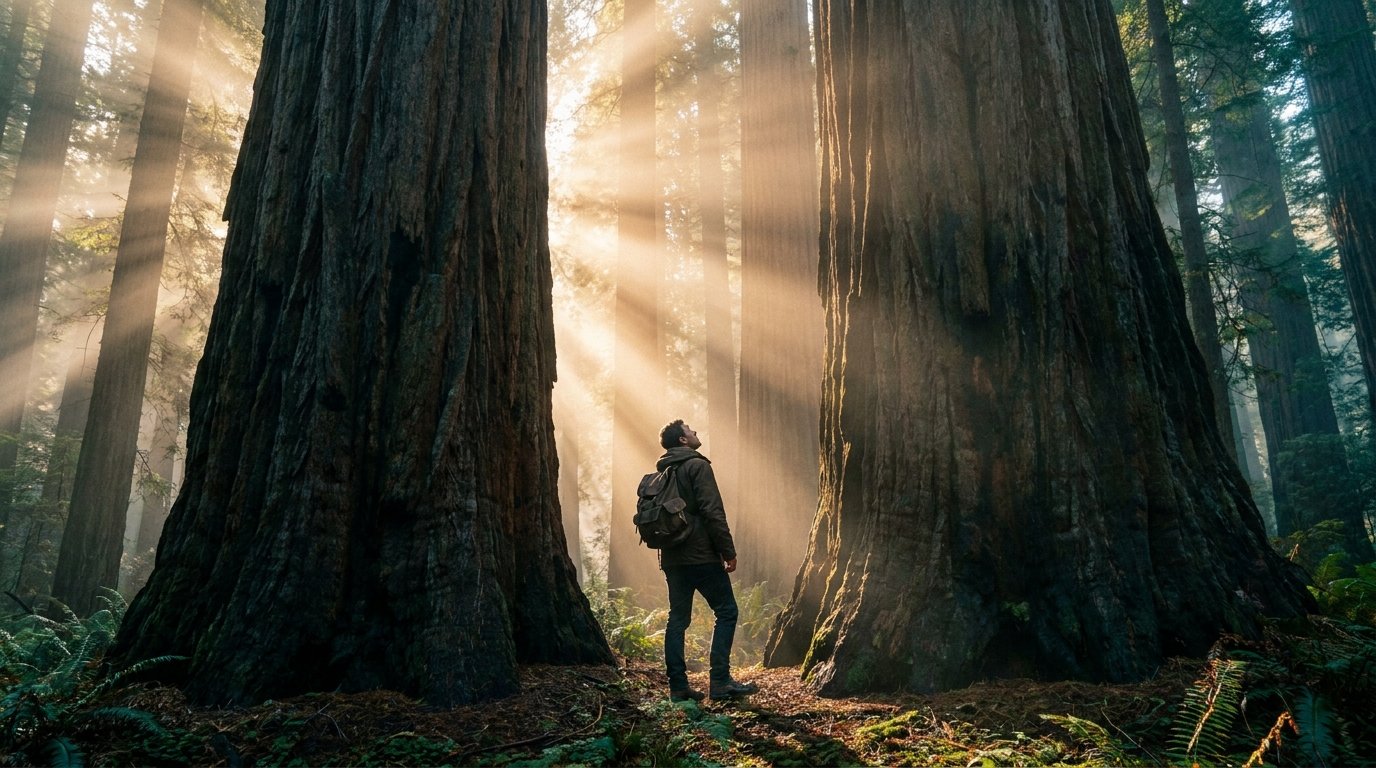
Think about the last time something genuinely stopped you. Not impressed you or made you smile, but actually halted the mental chatter for a second because what you were looking at felt bigger than you. For a lot of people, that memory takes a while to surface. Researchers now argue that the delay is its own kind of warning sign.
The reason is that awe turns out to be one of the only emotions science has connected to lower inflammation in the body. It quiets the brain’s background noise and, oddly, stretches your sense of how much time you have. Most adults go weeks without it, and not because it requires a mountain range. It requires attention, and our attention is almost always pointed somewhere else.
The Mental Fitness Podcast episode on the science of awe works through what the research actually found and how to build a practice around it. This is the deeper version.
What awe actually is
The working definition comes from psychologists Dacher Keltner and Jonathan Haidt, whose 2003 paper is still the foundation for the field. Awe is what you feel when you encounter something vast enough that it exceeds your current mental framework and forces you to update it. Vast can mean physical size, but it does not have to. An idea or an act of moral courage can qualify just as easily.
Two things have to be present. There is perceived vastness, and there is the need for accommodation, that small mental scramble to make room for something your existing categories do not quite fit. That is what separates awe from a merely pleasant sunset. Awe has an edge to it, a flicker of disorientation, a sense that what you are looking at is larger than you expected.
It helps to be clear about what awe is not. It is not the same as happiness or gratitude, even though they often travel together. And it is not a personality trait reserved for spiritual or unusually sensitive people. The physiological response appears to be universal. What varies from person to person is not the capacity for awe but where they happen to point their attention. That last point is why awe belongs in a conversation about mental fitness at all. It can be trained.
An emotion with effects you can measure
The most surprising research on awe comes from the body, not the mind. In a 2015 study published in the journal Emotion, Jennifer Stellar and her colleagues at UC Berkeley measured levels of a pro-inflammatory cytokine called IL-6, a marker closely tied to chronic stress and cardiovascular disease. They looked at how it related to a range of positive emotions. Of all of them, awe had the strongest link to lower inflammation. The people who reported feeling it most often carried the lowest levels of the marker.
Chronic low-grade inflammation works like an alarm system stuck in the on position, sounding when there is no fire, and most of the things that turn it down take real, sustained effort, like exercise and better sleep. What the awe research suggests is that a feeling, something you experience rather than something you do, is associated with the same kind of shift. And the people in the study were not summiting Everest. They were experiencing ordinary, recurring awe as part of daily life.
It quiets the mental background noise
There is a network in the brain called the default mode network, and it switches on whenever you are not focused on a task. Left to run, it narrates your inner experience and measures you against everyone around you. For a lot of people it runs too hot. It is the voice that will not quiet down when you are trying to fall asleep, and much of what mindfulness and therapy do is turn its volume down.
The hosts offer a useful analogy. Picture a computer with twenty browser tabs open and a dozen apps running in the background. The machine is not broken, just overloaded, and fixing each tab one at a time is not the answer. What it needs is a restart.
Awe is the restart. When something is genuinely vast enough to command your full attention, the brain routes its resources toward it, and the background chatter pauses. The problems have not gone anywhere. They will load back up when the system reboots, but for a moment, everything resets. It is the reason a few days in the mountains can feel like it cleared your head. It quite literally did.
It changes how much time you feel you have
One of the stranger findings involves time. In a 2012 study in Psychological Science, Melanie Rudd, Kathleen Vohs, and Jennifer Aaker induced awe in participants through video and writing exercises, then measured how much time people felt they had. Those in the awe condition reported feeling less rushed and more willing to give their time away to help others. The clock had not changed. Their experience of it had.
The researchers tie this back to attention. When you are buried in your own concerns, time feels scarce and every demand feels urgent. When your attention moves to something outside yourself, that pressure eases and time seems to open back up. For anyone who feels like there is never enough of it, that points to an unexpected lever. Sometimes the answer is not squeezing more efficiency out of the day. It is five deliberate minutes of perspective that change how the whole day feels.
It makes the self smaller
Dacher Keltner has studied awe longer than almost anyone, and one of his most consistent findings is what he calls the small self. Awe temporarily reduces the cognitive weight of your own concerns. Your worries and your comparisons do not vanish, but they shrink relative to whatever you are taking in. In a 2020 awe walk study led by Virginia Sturm with Keltner’s group, older adults took short weekly walks with an awe orientation for eight weeks. Over that time they began photographing themselves smaller in the frame, letting the landscape take up more of the picture, and they reported more compassion and less daily distress.
There is a simple way to picture the shift. Stress and anxiety work like a telephoto lens. Everything looks close and urgent, and the one problem in front of you fills the entire frame. Awe switches you to wide angle. It does not delete the problem. It just shows you how much else is in the frame alongside it, and suddenly the thing you were fixated on is not the size it seemed. The same research consistently found that people became more generous and cooperative afterward, which is close to the opposite of what a scroll through an outrage feed tends to do.
You do not need something dramatic
The most practical finding is also the simplest. Awe responds to attention, not scale. Most of us file it under things that require something enormous, the Grand Canyon or a view you get once in a decade. Those count, but Keltner’s awe walk research shows that a fifteen-minute walk through your own neighborhood, taken with the deliberate intention to notice, produces real and measurable benefits. Two groups took the same walk for the same length of time. The only difference was that one group was told to move through it with fresh, almost childlike eyes. That group came back measurably better off. What changed was where they aimed their attention.
The biggest thing standing in the way is the phone. Capturing a moment and being inside it are two different acts, and they compete for the same attention. The instinct to reach for the camera the second something is beautiful pulls you out of the wide-angle experience. It narrows you down to a three-inch screen, where you start thinking about lighting and angles instead of feeling anything. There is nothing wrong with a photograph. The fix is only a matter of sequence. Give yourself the first ten minutes to actually be there, and take the picture afterward.
A weekly awe practice
The episode lands on a simple four-step routine you can run once a week.
First, schedule the exposure. Awe rarely survives a packed calendar on its own, so block fifteen to thirty minutes for it, whether that is a walk somewhere green or a piece of live music. For people of faith, a weekly worship practice often does the same work.
Second, leave the phone behind, or at least keep it in your pocket for the first ten minutes. Experience first, document later.
Third, look with fresh eyes. Keltner’s instruction is to move through the time as if you were seeing things for the first time. A useful prompt is to ask, “What here is more complex or more beautiful than I usually notice?”
Fourth, name it afterward. One sentence is enough, something as small as the way the light broke through the clouds at six o’clock. Writing it down helps the moment stick and slowly trains the habit of noticing.
If you want a place to keep that habit, the NUE app is built around exactly this kind of noticing. A good prompt to use after an awe moment is simple: “What did I notice today that I usually walk past?”
A few predictable traps are worth naming too. One is setting the bar too high and waiting for the grand version, when the research says the ordinary one works. Another is documenting instead of experiencing, which is the phone problem again. And a third worth sitting with: awe does not have to feel good to count. It is defined by vastness, not by pleasantness. A violent thunderstorm overhead, or a film about a historical tragedy, can produce awe without any warmth at all, and those moments still deliver the perspective shift. Do not filter for only the pretty ones.
Try this
Reading about awe does almost nothing on its own. Pick one of these and actually run it this week.
- Book the block. Put one awe window on your calendar, fifteen to thirty minutes, and treat it like any other appointment.
- Pocket the phone. For the first ten minutes of that window, do not photograph anything. Just be in it.
- Take an awe walk. Head outside and move slowly, asking, “What here is more complex or beautiful than I normally notice?”
- Name it in a sentence. Afterward, write one line about what stopped you. No more than that.
- Lower the bar. Look for the ordinary version this week: a child noticing a bug on the sidewalk, or a song you actually stop to hear.
- Let the heavy ones count. If something vast and unsettling stops you, let it. Awe does not have to be comfortable to do its work.
The takeaway
Awe belongs in the same category as sleep and exercise. It is a mental fitness tool with measurable physiological effects, tied to your inflammation, your mental noise, your sense of time, and how you treat the people around you. The research is unusually clear that reaching it takes nothing dramatic. The vastness is already around you, most of it addressed to no one in particular, waiting to be noticed. Your only job is to actually look up.